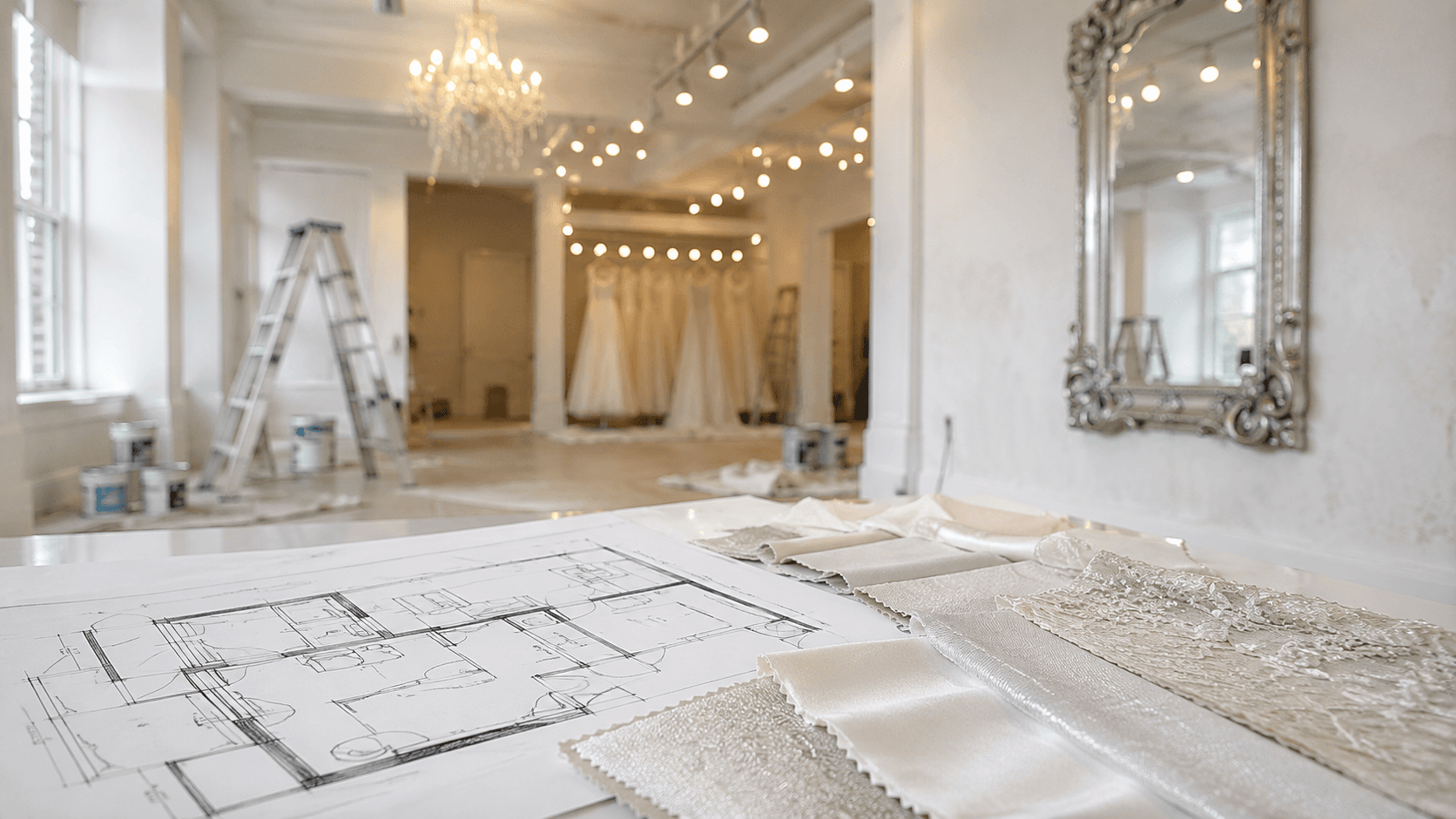
How Much Does It Cost to Open a Bridal Shop? A Line-by-Line Budget
The short answer: expect roughly $95,000 to $635,000, depending on your size, your market, and how much construction the space needs. A mid-sized boutique of about 1,800 sq ft in an average-rent market works out to around $265,000 in the worked example below. The long answer — the one that actually helps you write a business plan — is an itemized budget where each line has a driver you can control. That's what this guide walks through.
These are the same planning figures behind our free startup cost calculator, where you can plug in your own square footage and market and get an itemized estimate in about a minute. Treat everything here as planning numbers to pressure-test against real quotes in your market, not gospel.
The seven lines of a bridal shop startup budget
1. Buildout and renovation
Usually the biggest line. Bridal retail is experience retail: fitting rooms, a raised platform in front of good mirrors, and lighting that makes brides look the way they hope to look. That's construction, and construction is priced per square foot:
- Light refresh (paint, lighting swap, minor carpentry): around $15/sq ft
- Standard buildout (proper fitting rooms, platform, lighting design, flooring): around $60/sq ft
- High-end buildout (custom millwork, plumbing changes, designer finish): around $120/sq ft
A bridal buildout is lighter than many retail fit-outs. You rarely need a big stockroom or heavy store fixtures, but fitting rooms, the platform, and lighting are real construction. Published retail figures put a space that has already been used as a shop at roughly $40–80/sq ft to fit out, and raw space well above $100, which is where these planning numbers come from.
On an 1,800 sq ft space — a common size for a boutique with two to three fitting rooms — a standard buildout runs about $108,000 as a planning floor. Treat these per-square-foot figures as floors, not quotes. Recent construction pricing varies wildly by market and by the condition of the shell, and real bids for fitting rooms, electrical, and flooring often come in meaningfully higher. Get three bids before you believe any number, including ours.
This is also the line where lease negotiation matters most: a tenant improvement allowance or a few months of free rent from the landlord directly offsets it.
2. Opening sample inventory
The line with a deadline. You don't stock bridal gowns like t-shirts — you buy samples, one gown per style in a sample size. When a bride says yes, the shop measures her, orders against the designer's size chart (each designer's runs differently, sized to her largest measurement), and has her sign off on the size. That signature settles most sizing disputes before they start.
Opening assortments typically run 40 to 100 samples. Wholesale sample costs mostly fall between $500 and $1,200 per gown depending on your segment and designers, and a mid-market assortment often averages around $600–800. A 60-sample opening assortment at a $700 average is $42,000.
Here's the deadline part: made-to-order gowns commonly take 4–6 months to arrive, and some designers take longer. If you want to open in October, your sample orders go in by spring. Designer conversations — account minimums, territory exclusivity, delivery windows — should start before you sign a lease, not after.
If you're deciding how to split that budget across designers and price points, our open-to-buy planner does the buying math.
3. Fixtures, mirrors, seating, and decor
Racks hold gowns; the rest of the room sells them. Budget roughly $9/sq ft for fixtures, mirrors, the platform seating area for the entourage, and decor — about $16,000 on 1,800 sq ft. The two items worth over-spending on are mirrors and seating, because the bride looks at herself and her people watch her from a couch. Everything else can be upgraded later.
4. Technology and systems
Around $3,500. This covers your operating software, a card reader, a label printer, and a computer or tablet for the front desk. It's the smallest line in the budget, and the one that touches every appointment, sale, and gown you'll ever handle.
One structural decision matters here: one system or five. A boutique can run on separate booking, POS, spreadsheet-inventory, texting, and contract tools, and many do. But every gap between tools becomes re-typing, and re-typed bride details are how fittings get missed. Whatever you choose, set up online booking with deposits from day one — retrofitting a deposit policy after brides are used to free-cancel bookings is much harder. Our tech stack audit adds up what a patchwork actually costs if you want the comparison.
5. Opening marketing and signage
Around $5,000: exterior signage, a website with your booking link, opening photography, and a launch event. The highest-ROI moves at this stage are mostly cheap — a complete Google Business Profile, an Instagram presence that shows gowns arriving, and a grand opening that invites local photographers, planners, and florists. Those vendors are the people who will refer brides to you for years.
6. Lease deposits and first months' rent
Plan on roughly three months of rent due around signing (security deposit plus first month or two, varying by landlord). Bridal rent per square foot varies enormously by market:
- Modest market: around $18/sq ft/year
- Average US market: around $28/sq ft/year
- Premium metro: around $45/sq ft/year
Base rent is rarely the whole bill. Most retail leases are "triple net": on top of base rent, you pay a share of the building's property tax, insurance, and common-area upkeep, often $4–12/sq ft/year. Ask for that figure before comparing spaces, because two listings at the same rent can differ by hundreds a month. The calculator adds about $5, $7, and $10/sq ft/year for the three markets.
At 1,800 sq ft in an average market, that's about $4,200/month in rent plus about $1,050 in lease charges, so roughly $15,750 at signing. One thing that surprises first-time owners: bridal is a destination purchase. Brides book appointments and drive to you, so parking and a comfortable arrival matter more than walk-by foot traffic. You often don't need, or want, to pay Main-Street-retail rents.
7. Working capital
This is the line that decides survival, and the one everyone underestimates. Your samples are paid for months before your first gown order is delivered and paid in full, while rent and payroll run from day one.
Sales also take time to build. A new boutique might sell only a few thousand dollars in its first month and work up to roughly $10,000–15,000 a month by late in its first year, so first-year sales often come in at well under half of what an established boutique sells. Plan for the early months to run below break-even, and remember that what you sell isn't yet cash: brides pay a deposit when they order and the balance months later at pickup.
Budget at least six months of rent, lease charges, and staffing as a cash cushion for a lean shop, and nine or more for anything larger, because the higher your monthly costs, the longer a new shop's sales take to cover them. Add more if you'll also be covering loan payments, insurance, utilities, or a salary for yourself. At $5,250 a month for the space and $3,000/month of staffing, roughly one full-time stylist working alongside you, nine months comes to about $74,250.
Under-budgeting working capital is how shops with great openings die in month eight. If you have to cut somewhere else to protect this line, that's usually the right trade.
Three worked examples
Putting the lines together (same math as the calculator):
| Line | Lean (1,200 sq ft, modest market) | Mid-sized (1,800 sq ft, average market) | Premium (2,500 sq ft, metro) |
|---|---|---|---|
| Buildout | $18,000 ($15/sq ft) | $108,000 ($60/sq ft) | $300,000 ($120/sq ft) |
| Samples | $24,000 (40 × $600) | $42,000 (60 × $700) | $120,000 (100 × $1,200) |
| Fixtures | $10,800 | $16,200 | $22,500 |
| Tech | $3,500 | $3,500 | $3,500 |
| Marketing | $5,000 | $5,000 | $5,000 |
| Lease start | $6,900 | $15,750 | $34,375 |
| Working capital | $25,800 (6 months) | $74,250 (9 months) | $148,125 (9 months) |
| Total | ~$94,000 | ~$265,000 | ~$634,000 |
Rent is $18, $28, and $45/sq ft/year plus lease charges of $5, $7, and $10. Working capital covers six months (lean) or nine months (mid-sized and premium) of rent, lease charges, and staffing of $2,000, $3,000, and $5,000 a month.
The spread is real: a lean, well-run shop in a modest market can open for under $100k, while a premium metro boutique can pass $600,000. What separates plans that work isn't the total. It's whether working capital survived the cuts.
Where to save, and where never to save
Fair game for saving: buildout finish level (paint instead of millwork), decor (upgrade later from cash flow), the opening sample count at the margins (55 well-chosen samples beat 80 mediocre ones), and used fixtures.
Never save on: lighting (the highest-ROI construction dollar in a bridal store), fitting rooms and mirrors, working capital, and the deposit and booking system your no-show policy depends on. An empty Saturday slot costs more than any software subscription — our no-show calculator puts a number on that for your shop.
The timeline (work backwards from opening day)
- 6+ months out: business plan with a 12-month cash flow, entity/EIN/sales-tax registration, location scouting, and — critically — designer conversations, because sample lead times gate everything else.
- 4–6 months out: sign the lease (negotiate a buildout allowance and free-rent months), plan the floor around fitting rooms and the platform, order the buildout, and place sample orders.
- 2–4 months out: set up your operating systems — booking, deposits, inventory, POS, customer records. Configure online booking with deposits from day one. Hire and train your first stylist on consultations, not just transactions.
- 0–2 months out: Google Business Profile, website with booking link, Instagram. Run a friends-and-family soft launch to rehearse the full appointment flow, then a grand opening that seeds your local vendor referral network. Track where every appointment comes from starting on day one.
Financing notes
Most independent shops open on some mix of savings, an SBA-guaranteed loan (the 7(a) program is the common route for retail startups of this size), and occasionally landlord contributions via tenant improvement allowances. Two practical points. Lenders will ask for exactly the line-item budget and cash-flow projection described above. And vendor payment terms on your opening sample order are negotiable — asking established designers for split payment terms on the opening order is normal, and the worst they can say is no.
FAQs
Can I open a bridal shop with $50,000? At a fixed retail location, it's very difficult — the sample inventory alone strains that number. What does fit $50k is a by-appointment studio: smaller space, shorter buildout, 30–40 samples, low fixed costs. It's a common path — open by appointment, then move to full retail once demand proves out.
How many sample gowns do I need to open? Most boutiques open with 40–100. Below about 40, the store feels thin and brides leave without trying enough on. Above about 100, you're tying up cash in overlapping styles. Curation beats volume.
What's the single most common budgeting mistake? Treating working capital as the flexible line. It's the opposite — it's the line that pays rent in month seven while your first big gown orders are still on a boat.
How long until a new bridal shop is profitable? It varies too much to give an honest single number; market, rent, and buying discipline dominate. What you can control is the model: know your appointment capacity (our capacity planner computes it from rooms, stylists, and hours), your average sale, and your booking rate, and build your cash-flow projection from those.
Do I need software from day one? You need systems from day one: booking with deposits, customer records, inventory tracking, payments. Whether that's one platform or several is your call. The mistake is opening on memory and spreadsheets and trying to retrofit systems during your first busy season. If you want to see the all-in-one version, CloudBridal starts at $80/month with a 30-day free trial.
Planning your opening budget? Run your own numbers in the free bridal shop startup cost calculator — itemized for your square footage and market, with the opening checklist included.